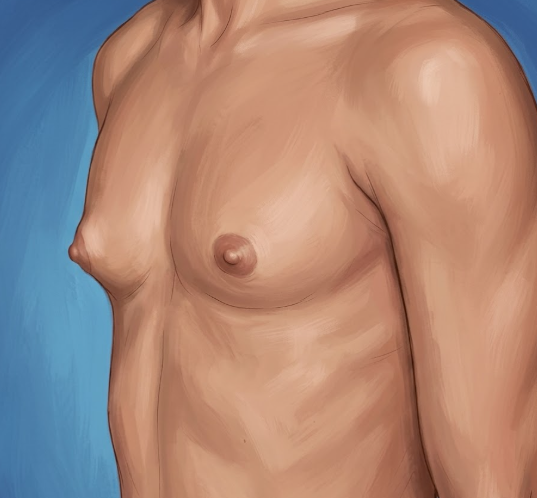
Gynecomastia is the benign growth of glandular tissue in the male breast. When it appears for the first time in adulthood, a medication, hormonal disorder, or systemic disease can be identified in roughly 45–50% of cases, so it should be worked up rather than dismissed as a change in body shape. Most cases do not need drug treatment: correcting the cause and observing for several months resolves a large share of them. This article follows the 2019 clinical practice guideline of the European Academy of Andrology (EAA) and the 2026 guideline of the Italian Society of Andrology and Sexual Medicine (SIAMS).

Gynecomastia vs. Pseudogynecomastia: How Doctors Tell Them Apart
The first question at any visit is whether the enlargement is glandular tissue or fat. Gynecomastia means proliferation of the breast gland. Pseudogynecomastia — also called lipomastia — is fat accumulation under the areola without glandular growth, and it is common in men who are overweight.
The distinction is made by palpation, not by looking. Both guidelines describe the same technique: the patient lies flat with his hands clasped behind his head, and the examiner slowly squeezes the breast between thumb and forefinger, moving toward the areola. In true gynecomastia, a firm or rubbery disc of tissue sits concentrically around the nipple and areola; recent-onset cases are often tender. In pseudogynecomastia, no such disc is felt. A subareolar disc of 2 cm or more in diameter is the threshold generally used in practice.
The distinction matters because it changes what happens next. Fat responds to weight loss; glandular tissue does not disappear with weight loss alone, and after roughly a year it becomes fibrotic and stops regressing at all.
| Feature | Gynecomastia | Pseudogynecomastia | Male breast cancer |
| Tissue | Glandular proliferation | Fat only | Discrete mass |
| Location | Concentric around the areola | Diffuse under the areola | Usually eccentric to the nipple, one side |
| Side | Usually both | Both | Usually one |
| Texture | Elastic to firm, may be tender | Soft | Hard, may be fixed |
| Other signs | None | None | Nipple retraction or discharge, skin ulceration, axillary nodes |
Three Life Stages When Gynecomastia Is Common
Breast tissue can enlarge normally at three points in a man’s life, and knowing which stage a patient is in largely determines how aggressively to investigate.
In newborns, transient breast enlargement occurs in an estimated 60–90% of infants, driven by maternal estrogens crossing the placenta. It usually settles within a few weeks as maternal hormone levels fall.
At puberty, about half of boys are affected, with the peak between ages 13 and 14. Aromatase — the enzyme that converts androgens to estrogens — matures early, so estrogen production rises before testosterone production catches up. Between 75% and 90% of cases resolve spontaneously within six months to two years, and only about 20% of boys still have residual breast enlargement at age 20.
In middle age and beyond, prevalence rises again: 30–65% of adult men have palpable breast tissue, and more than 70% of hospitalized elderly men do. Two age-related changes drive this. Sex hormone-binding globulin (SHBG), the carrier protein for sex steroids, increases with age and binds testosterone more avidly than estradiol, so bioavailable testosterone falls faster than estrogen. At the same time, increased body fat raises aromatase activity.

What Causes Gynecomastia in Adults?
Gynecomastia develops when estrogen action outweighs androgen action at the level of the breast tissue. This can happen even when both hormones measure within the reference range, because it is the ratio, not the absolute value, that matters at the receptor.
The recognized causes in adults are:
- Medications — 10–25% of adult cases, the single most common identifiable cause
- Testosterone deficiency — primary (testicular, including Klinefelter syndrome) or secondary (pituitary or hypothalamic)
- Endocrine disease — hyperthyroidism, hypothyroidism, and hyperprolactinemia
- Systemic disease — cirrhosis and chronic kidney disease
- Lifestyle exposures — chronic alcohol use, cannabis, and anabolic androgenic steroids
- Tumors — Leydig cell tumors, adrenal tumors, and germ cell tumors that secrete beta-human chorionic gonadotropin (β-hCG); 5–7% of germ cell tumors present with gynecomastia
Even after a full workup, roughly 25% of adult cases have no identifiable cause. That does not make the finding meaningless. A Danish nationwide register study published in the Journal of Clinical Endocrinology & Metabolism in 2023 followed 23,429 men diagnosed with gynecomastia against 117,145 matched men from the general population. Men with idiopathic gynecomastia — no known cause at diagnosis — still carried a higher risk of developing several disease categories during follow-up than their matched controls. Because register studies record diagnostic codes rather than clinical detail, they cannot prove causation, but the finding supports treating unexplained gynecomastia as a possible early signal of an underlying condition rather than a cosmetic issue.
Medications That Can Cause Gynecomastia
Drug-induced gynecomastia is the most common identifiable adult cause, so the medication history is the highest-yield part of the visit. Both guidelines rate careful review of prescriptions, over-the-counter products, and supplements as a strong recommendation.
| Drug class | Examples | Proposed mechanism |
| Antiandrogens | bicalutamide, flutamide, spironolactone | Androgen receptor blockade |
| 5-alpha reductase inhibitors | finasteride, dutasteride | Reduced dihydrotestosterone, higher estrogen-to-androgen ratio |
| GnRH agonists | leuprolide, goserelin | Suppression of testicular testosterone |
| Gastrointestinal drugs | cimetidine, omeprazole | Weak receptor blockade, reduced estradiol breakdown |
| Cardiovascular drugs | calcium channel blockers, digoxin, amiodarone | Unclear |
| Psychotropic drugs | haloperidol, tricyclic antidepressants | Raised prolactin, secondary hypogonadism |
| Other | antiretrovirals, statins, ketoconazole | Mixed mechanisms |
An apparent drug cause does not close the case. The EAA guideline is explicit that identifying a plausible medication should not stop a proper workup, because more than one cause is present in about 10% of patients.
How Is Gynecomastia Diagnosed?
Pubertal gynecomastia in an otherwise healthy boy usually needs only a physical examination; testing at that stage mainly produces overdiagnosis. Testing is directed at adult-onset, rapidly progressing, or atypical presentations.
Blood tests
The first-line panel in the SIAMS guideline is luteinizing hormone (LH), total testosterone, SHBG, albumin, prolactin, and β-hCG. Testosterone should be drawn in the morning after an overnight fast, and SHBG plus albumin allow free testosterone to be calculated rather than estimated.
Estradiol is measured selectively. Standard immunoassays lose accuracy at the low concentrations found in men, so liquid chromatography–mass spectrometry (LC-MS/MS) is preferred where available. Thyroid function, insulin-like growth factor 1 (IGF-1), liver and kidney function, and 17-hydroxyprogesterone are added according to the clinical picture.
Testicular ultrasound
Both guidelines recommend scrotal ultrasound once gynecomastia is confirmed. Palpation misses small testicular tumors, and a hormone-secreting tumor is the one cause that must not be found late.
Breast imaging
Imaging is not routine. It is used when the examination is equivocal or suspicious for cancer. Ultrasound is the preferred first study in younger men — under 35, and reasonably under 45 — while mammography is the initial study when malignancy is strongly suspected at any age, followed by core needle biopsy for tissue diagnosis. Ultrasound also distinguishes three patterns: nodular (florid, usually under one year), dendritic (quiescent, one year or longer), and diffuse. The pattern helps predict whether medical treatment is likely to work, since dendritic disease is largely fibrotic and responds poorly.
Does Gynecomastia Increase Breast Cancer Risk?
Gynecomastia is not a premalignant condition and does not raise the risk of male breast cancer, which carries a lifetime risk of about 0.1%. The reason cancer is discussed at every visit is not risk but differential diagnosis: a hard, one-sided mass outside the areola needs to be excluded before anything is called benign.
Age helps. Male breast cancer is virtually absent below age 35, and the median age at diagnosis is around 63. Klinefelter syndrome is the important exception, with a substantially elevated risk compared with other men, and the SIAMS guideline recommends annual breast examination in this group.
Treatment: Why Watchful Waiting Comes First
The default management is to correct the cause and wait. After stopping a causative drug, improvement is usually evident within about a month. If gynecomastia has been present for more than six months, fibrosis makes spontaneous regression unlikely, and after roughly a year it is uncommon. The recommended observation period is at least six months once the underlying cause is treated, extended to two years in pubertal cases.
Drug treatment has a limited and contested role, and this is where the two guidelines differ most.
| Treatment | EAA 2019 | SIAMS 2026 |
| Testosterone therapy | Only in proven testosterone deficiency | Only in proven testosterone deficiency |
| Tamoxifen | Not recommended in general | Suggested as a 3–6 month trial at 20 mg/day for recent-onset (<6 months) idiopathic cases |
| Transdermal DHT 2.5% | Insufficient evidence | Suggested as a 1–3 month trial in selected cases |
| Aromatase inhibitors, danazol | Not recommended | Not recommended |
| Surgery | For long-standing gynecomastia | For fibrotic disease or significant psychological distress |
Two points apply regardless of guideline. Giving testosterone to a man with normal levels can worsen gynecomastia, because the excess is aromatized to estradiol. And tamoxifen and dihydrotestosterone (DHT) are off-label for this indication everywhere, with transdermal DHT unavailable in many countries including the United States, so informed consent is essential.
Surgery is reserved for gynecomastia that has persisted beyond two years, has become fibrotic, or causes marked psychological distress. In adolescents it is generally postponed until puberty is complete, since operating earlier raises the chance of recurrence.
Gynecomastia During Prostate Cancer Treatment
Men treated with bicalutamide monotherapy for prostate cancer develop breast enlargement and breast pain frequently, and this is the one setting with randomized evidence for prevention. Prophylactic tamoxifen at 10–20 mg daily or a single course of radiotherapy at 10–15 Gy both reduce the incidence; aromatase inhibitors do not prevent these events and are not recommended.
The picture has broadened with newer agents. A 2025 systematic review and meta-analysis in European Urology Open Science reported that androgen receptor pathway inhibitor monotherapy caused more gynecomastia and breast pain than androgen deprivation therapy, whereas combining the two showed no significant excess over androgen deprivation alone. For men starting these treatments, this is worth raising before therapy begins rather than after breast tenderness appears, because prevention works better than treatment once fibrosis is established.
When to See a Doctor
Talk to your doctor, who may refer you to a urologist or endocrinologist, if any of the following applies:
- A firm mass on one side only, extending beyond the areola
- Nipple retraction or discharge, skin ulceration, or a lump in the armpit
- Rapid enlargement over a few months
- Reduced libido, erectile dysfunction, or fewer morning erections alongside the breast change
- Breast enlargement in a prepubertal boy
- Enlargement lasting more than two years or interfering with daily life
Frequently Asked Questions
Will losing weight get rid of gynecomastia?
It depends on which condition is present. Pseudogynecomastia is fat and improves with weight loss. True gynecomastia leaves a firm disc behind the areola that weight loss does not remove. Weight management still helps, because obesity raises aromatase activity and contributes to true gynecomastia in the first place.
How long does gynecomastia last?
Pubertal cases resolve in 75–90% of boys within six months to two years. In adults, the key window is the first six months: after that, fibrous tissue replaces the active gland and spontaneous regression becomes unlikely. This is why an early visit gives more treatment options than a delayed one.
Can supplements or anabolic steroids cause it?
Yes. Anabolic androgenic steroids are a well-recognized cause, since aromatizable androgens raise estradiol levels. One frequently cited analysis found undeclared anabolic steroids in about 15% of nutritional supplements tested. Stopping the substance is the first step, and the same six-month window applies.
Does gynecomastia turn into breast cancer?
No. Gynecomastia is benign and does not progress to cancer or increase its risk. Cancer is considered only as a separate diagnosis to exclude, which is why a hard, one-sided, non-central mass is investigated with imaging and biopsy.
Is gynecomastia painful?
Recent-onset gynecomastia is often tender, because tenderness reflects active hormonal stimulation of the gland. Long-standing fibrotic gynecomastia is typically painless. Pain that persists without any glandular tissue on examination should prompt a search for another explanation, such as infection or hematoma, rather than empirical drug treatment.
Key Takeaways
- Palpation comes first: glandular tissue forms a concentric disc of 2 cm or more under the areola, while pseudogynecomastia is fat with no disc.
- New adult-onset gynecomastia warrants a workup, since a cause is found in roughly half of cases and medications account for 10–25%.
- Testicular ultrasound is recommended once gynecomastia is confirmed; breast imaging is reserved for equivocal or suspicious findings.
- Correcting the cause and observing for six months is the mainstay; evidence for drug treatment is limited, and surgery is for fibrotic or distressing cases.
If you can feel a change in your breast tissue, have it examined rather than judged from a photograph or a symptom checker — the physical examination is what separates the three conditions described here.
References
- Pozza C, Selice R, Barbonetti A, et al. Management of gynecomastia in adolescence and adults: the clinical practice guidelines from the Italian Society of Andrology and Sexual Medicine (SIAMS). J Endocrinol Invest 2026 [Epub ahead of print].
- Tsuboi I, Schulz RJ, Laukhtina E, et al. Incidence, management, and prevention of gynecomastia and breast pain in patients with prostate cancer undergoing antiandrogen therapy: a systematic review and meta-analysis of randomized controlled trials. Eur Urol Open Sci 2025;73:31-42.
- Uldbjerg CS, Lim YH, Bräuner EV, et al. Increased morbidity in males diagnosed with gynecomastia: a nationwide register-based cohort study. J Clin Endocrinol Metab 2023;108:e380-7.
- Billa E, Kanakis GA, Goulis DG. Imaging in gynecomastia. Andrology 2021;9:1444-56.
- Kanakis GA, Nordkap L, Bang AK, et al. EAA clinical practice guidelines-gynecomastia evaluation and management. Andrology 2019;7:778-93.
This article is intended as general medical information and does not replace individual diagnosis or treatment. If you have symptoms, please consult a qualified healthcare professional.
Leave a Reply